What Makes AI-Powered Microdramas So Engaging?
Microdramas with AI work best when AI is treated as a fast production layer, not as a magic button that replaces the whole creative process. AI can help build characters, locations, shots, voices, edits, and localized versions, but the series still needs human control over story, continuity, pacing, and rights. The safest starting point is simple: use AI for speed and visual range, and keep people in charge of the decisions viewers actually notice.

Why AI microdramas are growing
AI microdramas are growing because they fit two things at once: phone-first viewing and the pressure to publish quickly. Viewers are already used to short vertical videos, and microdramas use that habit by packing conflict, reveals, and cliffhangers into very short episodes.
For creators, the appeal is practical. A small team can test a revenge plot, fantasy romance, or hidden-identity story without booking every location, hiring a large crew, or waiting for a traditional production schedule. That does not make every AI series good, but it lowers the barrier to trying more ideas.
Faster content production
AI can shorten the path from concept to usable footage. A creator can draft episode beats, test character looks, generate backgrounds, create rough scenes, and adjust edits much faster than in a live-action-only workflow.
Smaller production teams
A basic AI-assisted microdrama team may only need a story lead, a visual generation operator, an editor, and someone handling sound or voices. In a very small project, one person may cover several of those roles.
Lower location constraints
AI is especially useful when the story needs places that would be expensive or awkward to film: luxury mansions, palace halls, futuristic offices, magical worlds, stormy oceans, or large crowd scenes. Instead of building or renting every setting, creators can design a repeatable visual world.
Rapid growth in China
China has become the clearest example of how fast the microdrama model can scale. The duanju market already trained viewers to watch short serialized stories, and AI tools gave producers another way to increase output and reduce some production friction.
That growth is a useful signal, not a guarantee. It shows that AI can support high-volume production, but it also shows why quality control, licensing, and repeatable workflows become more important as output rises.
New AI-native projects overseas
Outside China, more teams are testing AI-native and hybrid vertical series. Some lean heavily on synthetic actors and generated scenes; others use AI only for backgrounds, dubbing, subtitles, concept art, or promotional assets.
The strongest overseas use case is often hybrid production. A fantasy romance may use AI for impossible scenery, while human writers and editors protect the emotional logic. A dialogue-heavy legal drama, on the other hand, may still be better with live performers and selective AI support.
How AI microdramas are made
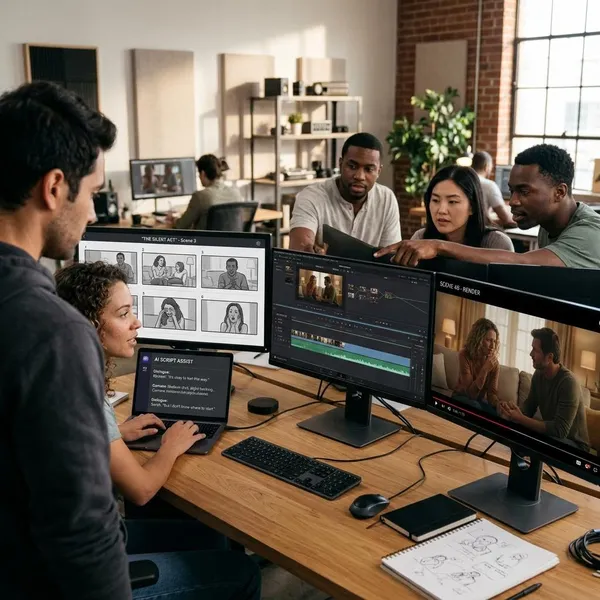
Most AI microdramas are made in a controlled sequence: plan the season, write strong hooks, lock the visual identity, generate scenes in small pieces, add sound, then edit and check continuity. The better the planning, the less time gets wasted fixing random output later.
- Story first: define the promise, conflict, and cliffhangers before generating footage.
- Visual rules second: lock character faces, wardrobe, locations, and recurring props.
- Shot control third: build scenes in manageable pieces instead of asking for one long perfect clip.
- Review last: check whether the episode still makes sense emotionally and visually.
Build the season arc
The season arc gives the microdrama its engine. A revenge story needs escalating payback, a romance needs obstacles and reveals, and a hidden-identity plot needs carefully timed exposure. Without that arc, AI can create attractive clips that do not make anyone want the next episode.
Write episode hooks
Each episode needs a fast reason to keep watching. That might be a betrayal at a wedding, a public accusation, a secret inheritance, a shocking text message, or a character entering a room where they clearly should not be.
Lock characters and locations
Before generating final scenes, teams should create approved references for lead characters and recurring places. This usually includes face references, hair and wardrobe rules, age range, expression examples, room layouts, lighting style, and any props that must stay consistent.
- For recurring leads: protect face shape, hairstyle, wardrobe logic, and signature accessories.
- For recurring spaces: keep entrances, furniture, color palette, and key props stable.
- For emotional scenes: save expression references, not only neutral character portraits.
Generate shots scene by scene
Shot-by-shot generation is usually more reliable than trying to create a full polished scene in one pass. A wide shot can establish the room, a close-up can carry the reaction, and an insert shot can highlight a ring, contract, phone screen, or clue.
Add dialogue and sound
Sound can make an AI microdrama feel much less synthetic. Voices, room tone, footsteps, music stings, crowd noise, and clean subtitle timing all help the viewer accept the scene.
AI voices may work for stylized or fast-turnaround projects, but human voice work is often stronger when the story depends on anger, shame, hesitation, or romantic tension.
Edit and check continuity
Editing turns generated clips into a watchable episode. The editor has to cut slow moments, make the hook land early, protect the emotional beat, and end with a clear reason to continue.
- Identity: do the main characters still look like themselves?
- Space: do rooms, doorways, props, and eyelines still make sense?
- Timing: do subtitles, voice, reaction shots, and cliffhangers land cleanly?
- Rights: are likenesses, assets, music, and voices approved for use?
What AI does well
AI is strongest where microdramas often need help most: speed, visual variety, dramatic settings, and fast localization. It is less about replacing every part of production and more about removing the bottlenecks that stop a small team from testing ideas.
The best fit is usually a story with bold emotions and clear visual signals. A cursed prince, a billionaire revenge plot, or a secret-heir reveal gives AI more room to succeed than a quiet room-based drama built on subtle acting.
Fast visual iteration
AI makes it easy to test different looks before production gets locked. A creator can compare a cold corporate office, a gold-lit mansion, and a darker palace corridor for the same confrontation, then choose the one that sells the mood fastest.
Fantasy and impossible settings
Fantasy, supernatural, historical, and high-status settings are natural AI use cases because they are expensive to film physically. Even if the result is slightly stylized, the visual scale can help a phone viewer understand the world immediately.
More creative variations
AI lets teams test alternate thumbnails, opening images, costumes, title cards, and cliffhanger frames quickly. That matters because small changes at the beginning of a short episode can affect whether viewers continue or swipe away.
Smaller-scale production
A small team can use AI to create sample episodes before spending heavily. This is a sensible route for early testing: make a short batch, watch where viewers drop off, then decide whether the concept deserves a larger investment.
It is not a shortcut around taste. Weak writing, confusing edits, or unstable characters will still lose viewers, even if the images look expensive.
Faster localization
AI can speed up dubbing, subtitle creation, alternate voice tracks, and localized promotional assets. A series that works in one market can be adapted faster for another, as long as names, tone, cultural cues, and on-screen text are reviewed by someone who understands the target audience.
What AI still struggles with
Current AI video still breaks down in places viewers notice: faces drift, acting can feel hollow, movement gets strange, and props may jump around between shots. These problems are not minor in a serialized story because recognition and continuity are what keep viewers emotionally attached.
Character consistency
Character drift is one of the biggest risks. A lead may look slightly different across shots, and small changes in eyes, hair, jawline, age, or body shape can make the audience lose track of who they are watching.
Natural performances
AI can create big expressions, but it often struggles with layered emotion. Anger is easier than anger mixed with embarrassment; fear is easier than fear hidden behind politeness.
Complex movement
Fight scenes, dancing, running, grabbing objects, and crowded blocking are still risky. Hands can deform, contact can look weightless, and bodies may move without believable balance.
If the action is essential, keep it short, simplify the blocking, or consider live-action reference material. Trying to make AI handle a long choreographed scene can waste more time than it saves.
Props and spatial continuity
AI often loses track of physical details. A phone may change hands, jewelry may disappear, a table may move, or a doorway may shift position between angles.
The fix is not glamorous, but it works: use establishing shots, keep a small prop list, and review the edit like a continuity checker rather than only judging whether each frame looks attractive.
Long dialogue scenes
Long conversations are difficult because they require stable faces, clean lip-sync, correct eyelines, and emotional progression across many cuts. A short confrontation can work; a five-minute nuanced argument is much harder.
For AI microdramas, it is usually better to break dialogue into sharp beats: accusation, reaction, reveal, choice, cliffhanger. That structure protects the pace and hides some technical weakness.
Rights and likeness control
Rights and likeness control need serious attention. Generated characters may resemble real people, voices may require permission, and visual or audio assets may have licensing limits depending on the tools used.
Creators should keep records of approved assets, voice permissions, music licenses, and any human likeness agreements. If the project is commercial or distributed through a platform, legal review is safer than assuming generated content is automatically clear to use.

How to make better AI microdramas
Better AI microdramas usually come from stricter choices, not more tools. The useful order is story, hooks, references, shot control, retakes, and review. If that sounds less exciting than "one prompt makes a series," it is also much closer to how watchable projects get made.
Think in terms of workflow fit. A solo creator making a proof-of-concept can accept some rough edges if the hook is strong. A studio releasing paid episodes needs tighter continuity, clearer rights, and more consistent characters.
Start with the story
Do not start with a pretty generated character and hope a series appears around it. Start with the promise: revenge after betrayal, fake marriage turning real, a hidden heir returning, a forbidden supernatural romance, or another conflict that can keep producing turns.
Each episode should push that promise forward. If a scene does not reveal, threaten, reverse, or intensify something, it probably does not belong in a short microdrama.
Design hooks first
Plan the first seconds and the final cliffhanger before filling in the middle. Those two moments decide whether the viewer enters the episode and whether they continue to the next one.
- Open with pressure: accusation, exposure, danger, humiliation, or an impossible choice.
- Make the hook readable: the viewer should understand the conflict without backstory.
- End with motion: a reveal, threat, decision, or reversal should pull the next tap.
Lock character references
Character references are not optional if the series has recurring leads. Save approved faces, wardrobe rules, expression samples, and key poses before generating final shots.
Generate shot by shot
Use shot-by-shot generation when quality matters. Build the scene through wide shots, medium shots, close-ups, inserts, and reaction shots instead of relying on one long generated clip.
This gives the editor choices. It also lets the team replace one weak moment without damaging the rest of the episode.
Plan for retakes
Retakes are part of AI production, so leave time for them. Expect some broken hands, wrong props, weak expressions, drifting faces, or unusable lip-sync.
Review every episode
Review each episode as a viewer, not only as a producer. Ask whether the hook is clear, the characters are recognizable, the emotional beat lands, the subtitles match the voice, and the cliffhanger gives a real reason to continue.
For higher-risk projects, add one more pass for likeness, licensing, music, voice use, and platform rules. Speed is useful only if the final release does not create avoidable problems.
Conclusion
AI can make microdrama production faster, cheaper to test, and visually more ambitious, but the best results usually come from a hybrid mindset. Use AI for iteration, settings, localization, and controlled shot creation; use human judgment for story, emotion, continuity, and rights. If the goal is a watchable series rather than a technical demo, the first thing to protect is not the tool stack but the viewer's ability to follow and care.