How Is AI Transforming China's Micro-Drama Market?
China's AI micro-drama industry is best understood as a fast production system, not just a wave of fully synthetic shows. Most successful projects still mix human actors, writers, editors, and platform judgment with AI tools that make scripting, visual planning, dubbing, editing, and overseas testing much faster. The practical question is no longer whether AI is involved, but where it improves speed without making the drama feel cheap, repetitive, or legally risky.
What is China's AI micro-drama industry?
China's AI micro-drama industry covers short serialized dramas made for phone viewing, with AI used somewhere in the production or distribution chain. That may mean simple tools such as subtitles and dubbing, or more ambitious systems that generate characters, scenes, voices, and promotional assets.
Mobile-first serialized dramas
Micro-dramas in China are built for vertical screens, quick decisions, and frequent cliffhangers. A viewer might watch three episodes during a metro ride, unlock the next one after a dramatic reveal, and move on quickly if the opening seconds feel weak. That pressure shapes everything: faster dialogue, simpler emotional stakes, sharper hooks, and little tolerance for slow setup.
AI-assisted live-action production
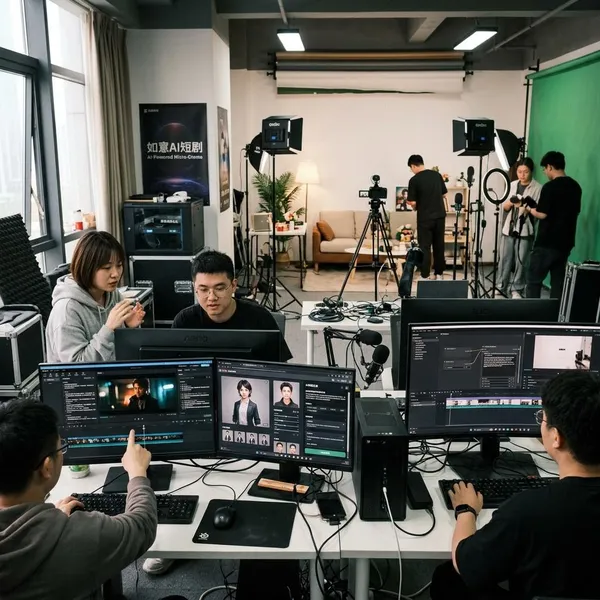
This is the most practical model for many studios. Actors still perform, crews still shoot, and editors still make judgment calls, but AI can help with storyboards, background extension, noise cleanup, subtitles, lip-sync support, thumbnails, and short promotional clips.
Fully AI-generated micro-dramas
Fully AI-generated micro-dramas rely on synthetic images, video, voices, and sometimes AI-drafted scripts for most of the finished product. They are most tempting for fantasy, historical, sci-fi, and animation-style stories because digital production can replace expensive sets, costumes, extras, and locations.
The weakness is consistency. If a lead character's face changes between episodes, or a palace corridor looks different in every scene, viewers notice. For that reason, fully generated dramas are interesting for experimentation, but they still need strong human supervision before they can reliably carry mainstream serialized storytelling.
How are Chinese AI micro-dramas made?
A typical Chinese AI micro-drama moves through a compressed pipeline: concept, script, visual planning, production or generation, dubbing, editing, localization, and app release. The first thing to check is how much of the pipeline is actually automated. A show with AI subtitles is very different from one built around synthetic actors and generated scenes.
Scripts and storyboards
AI is useful early because micro-drama writing depends on volume and speed. Teams can test several revenge hooks, romance setups, or episode endings before choosing the version most likely to survive the first-minute drop-off. Storyboards can also be generated quickly so directors and editors see whether a scene works on a vertical screen before money is spent filming or rendering it.
Characters and scenes
Character and scene work depends on the budget and genre. A low-cost live-action romance may only use AI for background cleanup or wardrobe references, while a fantasy title may use generated castles, crowds, monsters, or stylized digital characters.
| Production situation | Where AI helps most | What still needs checking |
|---|---|---|
| Small live-action shoot | Set extension, cleanup, promo images | Lighting match and visual continuity |
| Fantasy or historical story | Large scenes, costumes, digital extras | Stable faces, costumes, and locations |
| AI-first experiment | Characters, environments, motion, voices | Emotional realism and scene-to-scene consistency |
Voice and dubbing
Voice generation and dubbing are commercially important because they turn one title into several market tests. A studio can prepare English, Thai, Spanish, or Indonesian versions faster than with a fully traditional dubbing workflow, then watch which language version holds attention.
Editing and localization
Editing tools can find usable takes, clean sound, create captions, resize frames, and suggest tighter cuts. That matters because micro-dramas are judged quickly: a weak opening, confusing subtitle, or slow reaction shot can lose the viewer before the story has a chance.
Localization is more than translation. A joke, insult, family conflict, or romantic gesture may not land the same way in another country. For a quick overseas test, AI translation may be enough; for a serious market push, local review is the safer choice.
Final episode assembly
Final assembly turns the material into app-ready episodes: short openings, clean subtitles, strong thumbnails, balanced sound, and cliffhangers placed where the viewer is most likely to continue. AI can help compare alternate cuts, but the final question remains human: does this episode create enough curiosity to justify the next tap?
How is AI changing micro-drama jobs in China?
AI is not changing every job in the same way. The biggest pressure falls on roles that are repeatable, expensive to coordinate, or easy to simulate, while new work appears around AI video control, localization, synthetic media review, and rights management.
Fewer roles for some actors and extras
Background performers and minor roles are more vulnerable than lead actors. A crowd scene, office background, palace guard, or reaction shot can often be replaced with digital extras, especially in low-budget series where speed matters more than fine performance detail.
Less reliance on physical production crews
Crews are affected when studios use smaller sets, generated locations, digital backgrounds, and automated post-production. Historical and fantasy projects are especially exposed because AI can reduce the need for large practical builds.
More AI video and editing roles
New roles are appearing because AI output is rarely finished on the first attempt. Studios need people who can guide prompts, manage reference assets, correct visual drift, tune synthetic voices, test thumbnails, and decide which generated material is actually usable.
New work around digital likenesses
Digital likenesses create a new layer of production work. If an actor's face, body, or voice can be reused, someone has to manage consent, payment, usage limits, storage, disclosure, and takedown requests.
Why are Chinese AI micro-dramas going global?
Chinese AI micro-dramas are expanding overseas because the format already matches how many people use phones: short breaks, quick emotional payoff, and low commitment. AI adds a second advantage by making translation, dubbing, adaptation, and market testing cheaper.
Faster localization
AI can shorten the time between a Chinese release and an overseas test by generating subtitles, draft translations, voice tracks, and promotional copy. That speed matters when a plot type is trending and platforms want to move before audience attention shifts.
Lower-cost adaptation
Lower adaptation cost lets studios test more titles instead of betting everything on one export. A company can try several genres, languages, thumbnails, and episode cuts, then spend more only where retention and payment behavior look promising.
Global short-drama apps
Short-drama apps are a major reason the model travels. They combine distribution, payment, recommendation, testing, and user data in one place. That gives producers a direct feedback loop: which title gets opened, which episode loses viewers, which cliffhanger triggers payment, and which market deserves more promotion.
Mobile-first international audiences
The audience behavior already exists in many countries. People watch short videos during commutes, lunch breaks, late-night scrolling, or gaps between tasks. A three-minute drama episode fits those moments better than a long TV episode.
Where is China's AI micro-drama industry heading?
The next stage is likely to be less about proving that AI can make short dramas and more about proving that AI-assisted short dramas can keep quality, rights, and localization under control. Speed helped the sector grow, but speed alone will not protect it from audience fatigue or legal disputes.
The strongest players will probably be the ones that know when not to automate. Use AI for scale, testing, and repetitive production work; keep humans close to performance, cultural judgment, rights decisions, and final story taste.
More hybrid AI-human production
Hybrid production is likely to remain the mainstream path. It gives studios the cost and speed benefits of AI while keeping humans responsible for the parts viewers notice most: emotion, timing, conflict, chemistry, and taste.
Better character and scene consistency
Consistency will become a serious quality marker. Viewers may forgive a simple set or melodramatic plot, but they are less forgiving when a character's face shifts, clothing changes without reason, or a familiar location looks rebuilt every episode.
- Reference assets: fixed images, voices, costumes, and style rules for recurring characters.
- Review loops: human checks before scenes are locked.
- Reusable models: production systems designed for a whole series, not one-off clips.
Stronger rights and disclosure standards
Rights and disclosure standards will become more important as synthetic media becomes normal. The more realistic AI faces and voices become, the more pressure there will be to clarify what was generated, what was licensed, and what was performed by a real person.
Clear rules can support growth rather than slow it. Performers know what they agreed to, platforms reduce risk, advertisers avoid awkward disputes, and viewers are less likely to feel misled.
Greater focus on global localization
Global growth will move beyond simple translation. Successful overseas releases may need local actors, rewritten scenes, region-specific marketing, or partnerships with teams that understand local humor, romance expectations, payment habits, and platform behavior.
AI can still make that work lighter. But when a market becomes important, human local judgment becomes the difference between a quick test and a sustainable audience.
Conclusion
China's AI micro-drama industry is moving toward a practical middle ground: not fully automated entertainment, but faster human-led production supported by AI wherever speed, cost, and localization improve. The winners will not be the studios that generate the most material; they will be the ones that keep characters consistent, protect likeness rights, adapt properly for overseas viewers, and still make each short episode feel worth the next tap.