Why Are Chinese AI Short Dramas Taking Off?
Chinese short drama AI usually means a mobile-first micro-drama made fully or partly with AI tools, from synthetic actors and backgrounds to AI voices, effects, subtitles, or editing support. The format is growing because it lets producers test dramatic story ideas faster and more cheaply, but the winners are not simply the teams that generate the most clips. The real question is whether the finished series feels clear, watchable, legally safe, and different enough from the flood of similar AI dramas.
What is Chinese short drama AI?
Chinese short drama AI refers to short, vertical drama episodes made with artificial intelligence at some point in the production process. Some titles are almost entirely synthetic, while others are ordinary live-action micro-dramas that use AI for dubbing, visual effects, background generation, editing, or marketing assets.
Fully AI-generated micro-dramas
Fully AI-generated micro-dramas use software to create most visuals and audio. Characters, locations, camera movement, voices, and sometimes music can all come from generative tools rather than a physical shoot.
AI-assisted live-action dramas
AI-assisted live-action dramas still rely on real performers and filmed scenes, but AI reduces the workload around them. A team might use AI for background replacement, dubbing, voice cleanup, de-aging effects, synthetic crowd shots, or promotional images.
Animated and photoreal AI dramas
Animated AI dramas can lean into fantasy without pretending to be live action. That makes them useful for cultivation stories, monsters, magical battles, ancient palaces, and other scenes that would be costly to film.
Why is Chinese short drama AI growing so fast?
The growth comes from a good match between AI production and China's short-drama market. Micro-dramas already reward speed, volume, cliffhangers, and mobile viewing. AI gives producers a way to make more tests without building a full shoot around every idea.
Lower production costs
AI can reduce spending on locations, sets, travel, wardrobe, extras, some visual effects, and sometimes actors or voice performers. That does not make production free, but it changes the risk calculation.
Faster production cycles
Speed is a major advantage because short-drama trends move quickly. When a certain trope starts performing well, such as hidden identity, rebirth, forced marriage, or status reversal, AI lets teams create related concepts while the audience is still interested.
Smaller production teams
Some AI drama projects can be handled by a compact team focused on scripts, prompting, clip selection, audio, subtitles, and editing. That makes the format attractive to startups and smaller content companies that cannot run a full live-action set.
The trade-off is hidden labor. Someone still has to reject bad generations, fix continuity, check rights issues, and make the episodes feel coherent. A smaller team can move faster, but it cannot skip judgment.
More freedom for fantasy and spectacle
AI gives creators cheap access to palaces, glowing battle scenes, luxury interiors, supernatural weather, mythic creatures, and impossible landscapes. On a phone screen, that can be enough to make a low-budget story feel bigger than it is.
This advantage is strongest for short, punchy spectacle. It is weaker for slow character drama, where viewers notice whether a face, pause, or reaction feels real.
How are Chinese AI short dramas made?
Chinese AI short dramas are usually built through a production pipeline rather than created with one prompt. The story is broken into short scenes, characters and settings are designed, many clips are generated, the usable shots are selected, and the final episodes are edited for vertical mobile viewing.
The most important practical check is continuity. If the lead character's face changes, the background jumps between styles, or the voice does not match the emotion, viewers may leave even if the plot is strong.
Scripts are split into short scenes
Scripts are divided into small dramatic beats because AI video tools are easier to control in short units. Each scene needs one clear job: reveal a secret, show betrayal, raise the stakes, create a reversal, or push the viewer into the next episode.
Characters and settings are generated
Teams define the character look, clothing, age range, mood, lighting, and setting style before generating full scenes. Strong projects lock these choices early so the same lead does not look like a different person from one episode to the next.
- Check the lead face first: inconsistent faces damage trust quickly.
- Keep locations readable: offices, mansions, hospitals, and palaces should not blur into the same generic background.
- Use style on purpose: a clear animated style can be better than uneven photorealism.
AI clips are generated and selected
Clips are generated in batches, and many are thrown away. A shot may fail because a hand warps, the eyes drift, the face changes, or the movement does not match the emotion of the scene.
This is where the "card puller" role sometimes appears in AI short drama production. The person keeps generating and adjusting prompts until a usable clip appears. The skill is not only writing prompts; it is knowing when a clip is good enough, when it should be regenerated, and when the scene needs to be simplified.
Voice, music, and subtitles are added
Voice and subtitles can make or break an AI drama. Many viewers watch short videos without sound, so subtitles need to be large, timed well, and easy to understand at a glance.
AI voices are useful for speed, but flat delivery can weaken revenge, confession, breakup, and reunion scenes. If only a few moments deserve extra care, the emotional peaks should get it first.
Episodes are edited for mobile viewing
Final editing is built around vertical framing, close-ups, readable text, quick transitions, and cliffhanger endings. The first seconds need to tell the viewer what conflict they are watching and why it matters.
Why do Chinese AI short dramas struggle to stand out?
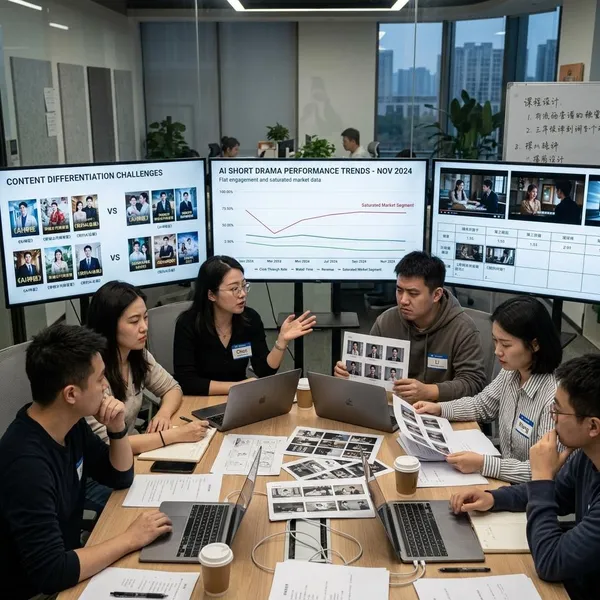
Chinese AI short dramas struggle because the same tools that lower barriers also increase sameness. When many teams can generate similar faces, plots, and fantasy scenes, the hard part shifts from production to differentiation.
Too many new titles
The supply of short dramas can grow faster than audience attention. That means packaging matters before the story even has a chance: title, thumbnail, first shot, character design, and opening conflict all need to work quickly.
If the first scene looks like a generic CEO romance or another recycled rebirth plot, many viewers will not wait to find out whether the later episodes improve.
Repetitive story formulas
Revenge, rebirth, hidden heirs, mistaken identity, forced marriage, and billionaire romance remain popular because they are easy to understand fast. The problem starts when AI makes these formulas even easier to copy.
Similar AI characters
Many AI characters share the same polished skin, lighting, facial proportions, and limited expression range. In a fantasy animation, viewers may accept that more easily. In a photoreal romance, it can feel uncanny or cheap.
Distinct character design matters more than perfect beauty. A memorable face, costume silhouette, or visual mood can help a title stand out faster than another flawless but forgettable synthetic lead.
Low breakout rates
Low production cost does not remove the need for audience attachment. Many AI dramas can be made and released, but only a small portion will gain the attention, retention, or paid viewing needed to become meaningful successes.
- For small teams: AI is useful for testing ideas, but promotion and retention still decide results.
- For platforms: more titles keep feeds active, but too much sameness can reduce trust.
- For viewers: the first episode is the filter; if the hook is weak, the production method does not matter.
What are the risks of Chinese AI short dramas?
The main risks are copyright disputes, likeness misuse, repetitive synthetic content, unclear AI labeling, and viewer fatigue. These risks matter because AI short dramas sit close to entertainment, identity, platform rules, and commercial rights.
Copyright disputes
Copyright risk can appear when scripts, images, voices, footage, music, or visual styles are copied too closely from existing works. Even when the legal rules are still developing, platforms and rights holders can still challenge suspicious content.
Studios should be especially careful with projects that imitate famous actors, known drama posters, recognizable fantasy worlds, or copyrighted music. The saving from AI production can disappear quickly if a title faces takedowns or licensing complaints.
Likeness and face-use concerns
Photoreal AI faces create a separate problem: a character may resemble a real performer, influencer, or private person. Sometimes that resemblance is intentional; sometimes it happens through reference images or model output.
The cautious choice is to use properly licensed references and avoid faces that could be mistaken for real people. This matters most in commercial dramas, paid apps, advertising materials, and overseas distribution where complaints can spread quickly.
Repetitive AI-generated content
Repetition is not only a creative weakness; it can become a brand problem for the whole category. If viewers keep seeing the same synthetic faces, plots, voices, and lighting, they may start treating AI short dramas as low-effort filler.
Creators should check for sameness before release, not after the audience complains. If the title could be renamed and mistaken for five other dramas, it needs a stronger concept or a clearer visual identity.
AI labeling and platform rules
Platform rules around synthetic media are likely to keep changing. Some platforms may require labels for fully AI-generated video, cloned voices, realistic synthetic faces, or manipulated scenes that could mislead viewers.
The practical risk is uncertainty. A team using AI only for subtitles is not in the same position as a team using synthetic actors and cloned voices. Keeping internal records of tools, assets, and permissions makes it easier to respond if a platform asks questions.
Viewer fatigue and trust issues
Viewer fatigue grows when audiences feel tricked, bored, or overwhelmed by near-identical uploads. Trust drops even faster if a drama appears to use someone's face or voice without permission.

Conclusion
Chinese short drama AI is useful when speed, low-cost testing, and visual scale matter more than subtle live performance, but it is not a shortcut to automatic success. The strongest projects will likely be the ones that use AI selectively, protect rights carefully, give viewers a clear reason to keep watching, and avoid looking like one more recycled synthetic drama in the feed.